
At a certain point in every Monster Energy Supercross season, the noise begins to recede. Illusions fade, patterns emerge, and riders stop suggesting who they might be and begin showing who they are.
The 2026 season is beginning to reveal its shape, and Eli Tomac remains the reference point.
Glendale did little to change that — even if the results suggested otherwise.
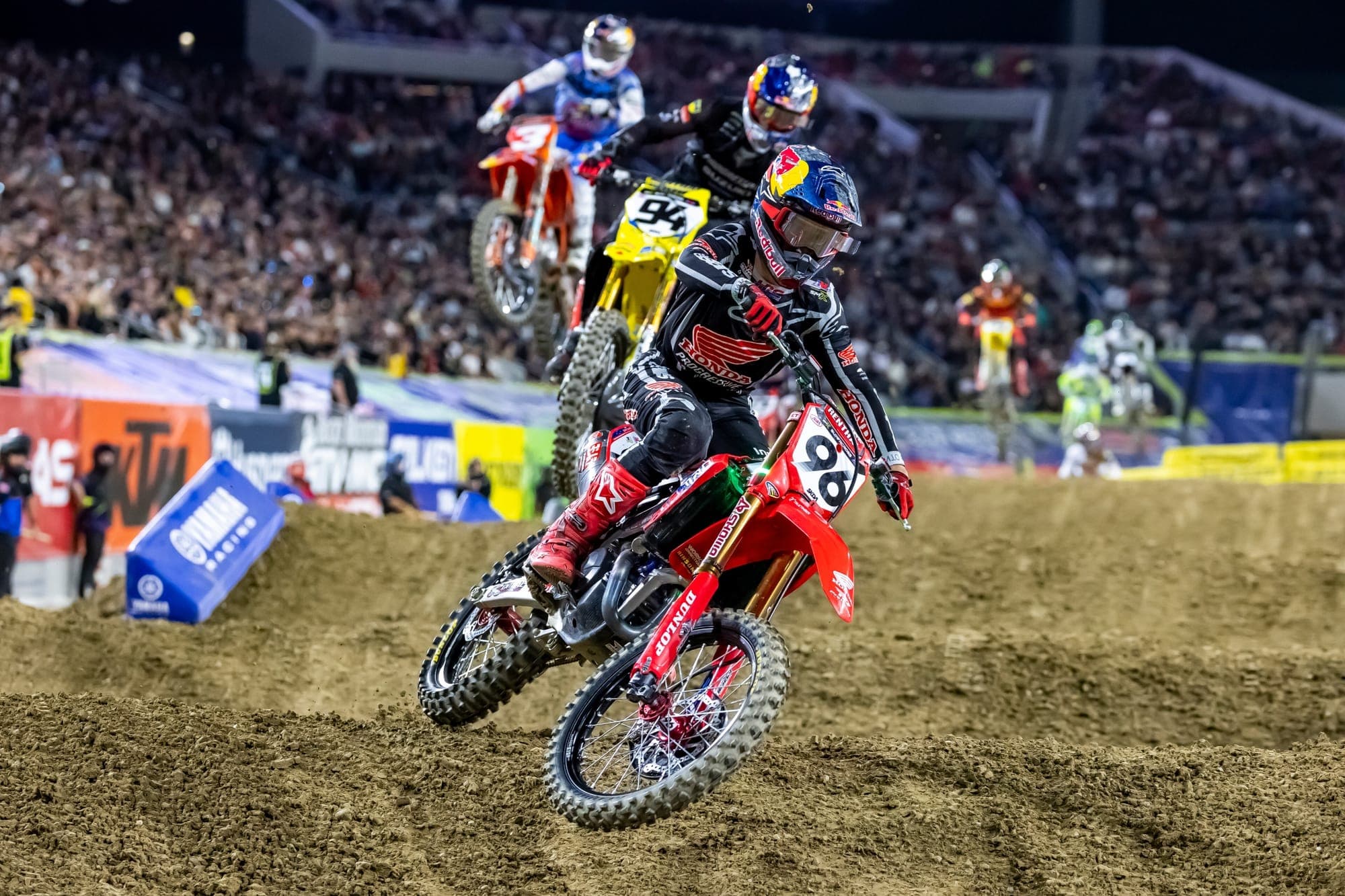
Tomac arrived looking every bit the rider to beat, impressive in qualifying and composed in his heat race. Then, a small mistake placed him in a vulnerable position entering the first turn of the main event. The resulting tangle left him on the ground and at the back of the field.
What followed was more instructive than the incident itself.
There was no visible panic. Tomac rebuilt the race methodically, moving through the field and recording one of the fastest laps of the night despite the circumstances. A 12th-place finish scarcely reflects the pace he demonstrated after remounting — a reminder that in a class defined by microscopic margins, position often dictates possibility.
Ken Roczen, meanwhile, delivered the sort of ride that reveals intent. His victory was not opportunistic; it was controlled. He started well, assumed control early, and carried that momentum from the opening lap. Roczen's fastest lap, a 56.700, stood as the benchmark of the race, underscoring both speed and authority.
Veteran riders rarely speak openly about championship ambitions in February. They do not need to. Performances of this nature communicate clearly enough.
If Roczen rode like a contender, Tomac continues to ride like the rider others must orient themselves around.
Perhaps the defining characteristic of the opening five rounds is not dominance, but compression. The front of the 450SX field remains unusually dense: Roczen within striking distance, Hunter Lawrence holding the points lead, Cooper Webb quietly assembling results, and Jorge Prado continuing to validate his early-season promise.
No one is in control.
Control, however, may not be the requirement this championship ultimately demands.
So far, this is a season governed by speed — and by the increasingly narrow window available to use it. Starts have become less negotiable with each passing round, not merely because they provide track position, but because the pace at the front leaves little room for recovery. Even elite riders struggle to manufacture podiums from deep in the pack when lap times converge this tightly.
Glendale reinforced that reality. Tomac's charge from last toward the middle of the field was impressive. It was also a quiet illustration of the limitation now facing the entire class: without early track position, even the fastest riders are often reduced to damage limitation.
Championships are frequently defined by a rider's most difficult nights. If that holds true again, Glendale may ultimately register less as a setback for Tomac than as evidence of his floor.
Five rounds have clarified something essential. Tomac may possess the strongest title potential — but the margin for error separating contender from champion is vanishingly small.
In a season shaped by margins, precision is unlikely to be optional.